
Medically reviewed by Dr Dhivian, MBBS, MMed (Family Medicine), Accredited Family Physician, Angsana Medical
The short answer
A family doctor is your first point of contact for almost any health concern. They treat everyday illness, manage long-term conditions, coordinate your care and, most importantly, get to know your history over the years so advice is personal rather than generic.
Most people only think about a doctor when something is wrong. A family doctor is meant to be the opposite of that: someone you see when you are well as much as when you are unwell, who holds the bigger picture of your health over time. If you have ever wondered what a family doctor actually does day to day, or whether it really matters to have a regular one rather than dropping into whichever clinic is nearest, this article is for you.
What a family doctor actually does day to day
A family doctor, also called a general practitioner or GP, is a primary care doctor. That means they are the first person you turn to for almost any health concern, before anything more specialised is needed. The range is genuinely broad, which is part of what makes the role so useful.
On a typical day a family doctor will see acute, short-term problems: coughs and colds, fevers, stomach upsets, skin rashes, urinary infections, minor injuries and the many everyday complaints that do not need a hospital but do need a proper assessment. The skill is not only in treating what is in front of them, but in spotting the small number of cases that look minor yet are not.
Alongside this, a family doctor manages long-term conditions. High blood pressure, diabetes, high cholesterol, asthma and thyroid problems are mostly looked after in primary care, with regular reviews, medication adjustments and monitoring of your blood tests over time. This ongoing work is the backbone of what we do, and you can read more about it on our page on long-term condition management.
The role also covers a lot of preventive and whole-person care. That includes health screening, vaccinations, travel health advice, women's and men's health concerns, mental health support, and guidance on weight, sleep, smoking and lifestyle. Family doctors handle minor procedures too, such as wound care, removing small skin lesions and minor injections. And when something falls outside the scope of primary care, the family doctor decides what investigation is needed and refers you to the right specialist with a clear summary of your history.
In short, a family doctor is a generalist by design. They are trained to deal with undifferentiated problems, meaning symptoms that have not yet been sorted into a neat diagnosis, and to manage the ordinary alongside the occasional serious. For most people, most of the time, the family clinic is where care should begin.
Family physician vs GP vs specialist: what is the difference and when to see each
These terms cause a fair bit of confusion, so it helps to set them out plainly. In Singapore, GP and family physician are often used to mean the same thing, both referring to a primary care doctor. The difference, where there is one, is in training. A family physician must be accredited by MOH and is usually a GP who has completed further postgraduate qualifications in family medicine, such as the GDFM (Graduate Diploma in Family Medicine) or the MMed (Master of Medicine in Family Medicine), with a particular focus on caring for the whole family over the long term. So family physician versus GP is less a hard line and more a matter of depth of training within the same field of primary care. Amongst family physicians, those with a MMed have undergone more rigorous training and accreditation. These family physicians are equipped to deal with more complex primary care issues.
A specialist is different. Specialists, such as cardiologists, dermatologists or endocrinologists, focus deeply on one organ system or area of medicine. They are the right choice when a condition is complex, when it needs procedures or tests that only that specialty provides, or when your family doctor has assessed you and decided the problem needs that focused expertise. The trade-off is that a specialist sees one part of you in detail, while your family doctor sees all of you over time.
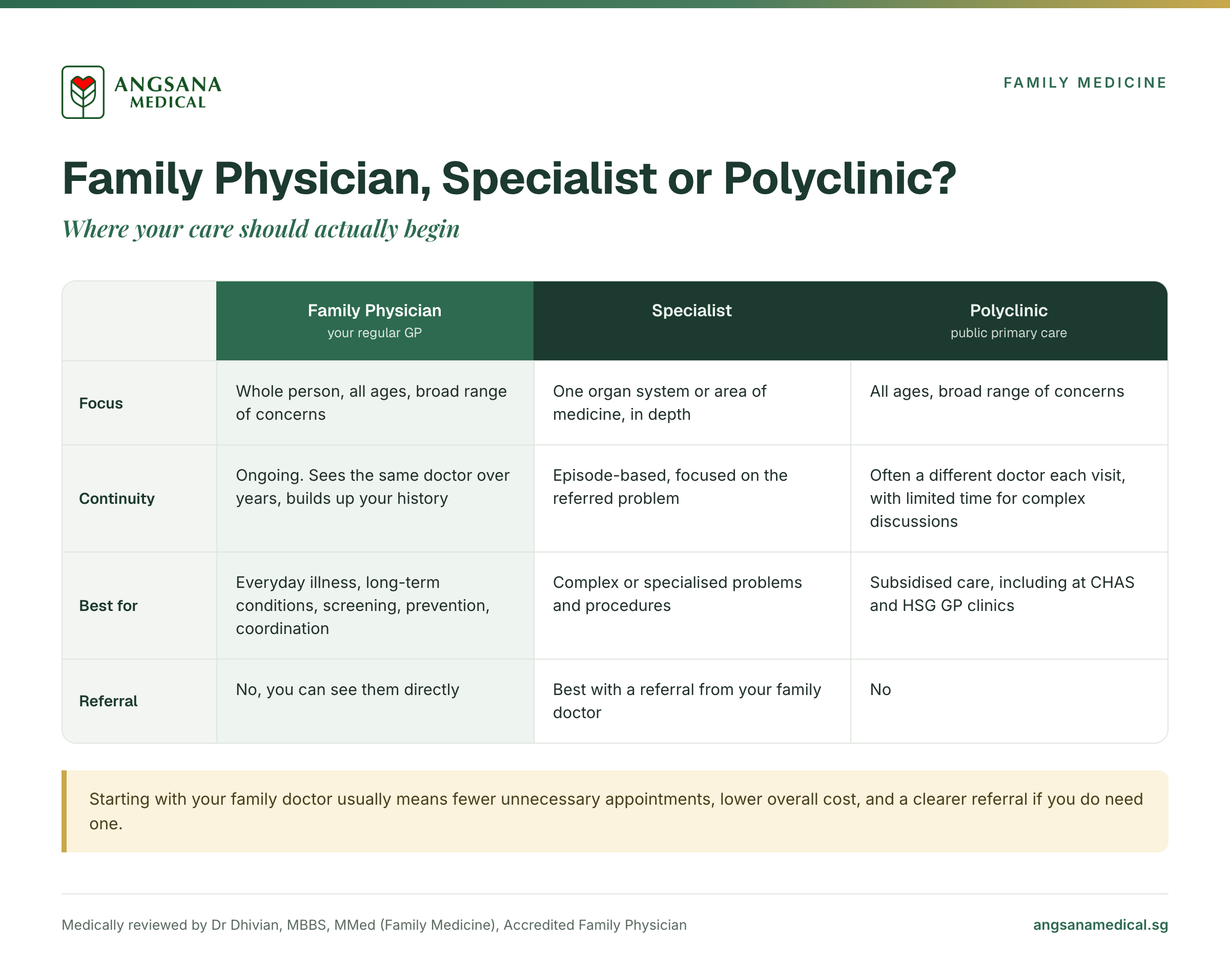
This is why GP versus specialist is rarely an either-or. They work best together. Your family doctor handles the everyday, screens for problems early, and acts as the coordinator who knows your full history, while specialists step in for the deeper, narrower questions and then hand the ongoing care back. Starting with your family doctor usually means fewer unnecessary appointments, lower overall cost, and a clearer referral if you do need one. Seeing an experienced family physician usually means more complex care can be handled in the primary care setting before a referral to a specialist is required.
Family physician vs specialist vs walk-in or polyclinic
| Family physician (regular GP) | Specialist | Polyclinic | |
|---|---|---|---|
| Focus | Whole person, all ages, broad range of concerns | One organ system or area of medicine, in depth | All ages, broad range of concerns |
| Relationship and continuity | Ongoing; sees the same doctor over years, builds up your history | Episode-based, focused on the referred problem | Often a different doctor each visit, with limited time available for complex discussions |
| Best for | Everyday illness, long-term conditions, screening, prevention, coordination | Complex or specialised problems and procedures | Subsidised care (subsidies are also now available at CHAS and HSG GP clinics) |
| Referral needed | No, you can see them directly | Best with a referral from your family doctor; required for subsidised public specialist care | No |
Why continuity of care matters
The single biggest reason to have a regular family doctor is continuity. When the same doctor sees you over months and years, they are not starting from a blank page every time. They know your medical history, your medications, your allergies, the conditions that run in your family and the small but telling changes in your numbers and your symptoms. Studies in family medicine have explored how continuous, relationship-based care relates to health outcomes over time. Your doctor can explain what that continuity means in practice for you.
That history is not a luxury, it is clinical information. A blood pressure reading means more when your doctor can compare it against your readings from the past three years. A new symptom is easier to interpret when your doctor already knows your baseline. A mood that seems flat is easier to notice when someone has seen you well before. A doctor who is meeting you for the first time has none of this, and has to work harder to piece it together from what you happen to remember in the room.
Continuity also changes the texture of a consultation. A relationship built over time means you are more likely to mention the thing you came in worried about but were too embarrassed to raise, and more likely to follow through on a plan you helped shape. At Angsana, our approach is built around this. We keep consultations long enough to listen properly rather than rushing you out, we aim for you to see the same doctor at each visit where possible, and we treat your record as a continuous story rather than a series of disconnected appointments. You can read more about how we work on our family medicine and general practice page.
None of this means your family doctor handles everything alone. Part of good continuity is knowing when to bring in others and then folding their findings back into your overall care, so that the picture stays whole. The point is that there is one doctor who holds the thread.
 A family doctor in Singapore talking through a patient's health concerns at an unhurried consultation.
What to expect at your first visit and how to prepare
If you have not had a regular doctor before, a first visit can feel like a lot of admin. It does not have to be. Knowing what to expect at a doctor's appointment, and doing a little preparation, makes the consultation far more useful.
A first visit usually starts with the doctor taking a full history. Expect questions about your current concern, your past medical conditions, any operations, your regular medications and supplements, allergies, family history of illness, and lifestyle factors such as smoking, alcohol, exercise, sleep and stress. This is the foundation the rest of your care is built on, so it is worth giving honest, complete answers even to the questions that feel routine. Depending on why you are there, the doctor may then examine you, arrange blood tests or a basic health screening, and discuss a plan with you.
Here is how to prepare for a doctor's appointment so you get the most from it:
- Write down your main concerns in advance, and put the one that worries you most at the top
- Bring a list of all medications and supplements you take, or simply bring the boxes
- Note any allergies and past reactions to medicines
- If relevant, bring results, referral letters or discharge summaries from other clinics or hospitals if you have them
- Jot down dates and details: when symptoms started, how often they happen and what makes them better or worse
- Note relevant family history, such as a parent with diabetes, heart disease or cancer
- Write down any questions you want to ask, so you do not remember them only after you leave
If your visit includes a check on your general health rather than a specific complaint, your doctor may suggest a more structured assessment. The depth and frequency of that is a topic in itself, and we cover it separately in our guide to health screening. For a first visit, the most valuable thing you can bring is simply a clear account of your health and what you would like help with.
How to choose a family doctor in Singapore
Choosing a family doctor is a more personal decision than choosing most other services, because the value comes from the relationship over time. A few practical considerations will steer you well.
Convenience matters more than people expect. A clinic that is near your home or workplace, with hours that suit your schedule, is one you will actually return to, and continuity only works if you keep coming back. Beyond logistics, think about how the consultation feels. Do you feel listened to? Is the doctor willing to explain things in plain language and answer your questions? Are appointments unhurried enough to discuss what you came for? These are the qualities that make you comfortable raising the concerns that matter.
It is also worth considering the doctor's training and the range of services the clinic offers, so that as your needs change, from routine illness to long-term condition management to screening and preventive care, you can be looked after in one place by someone who knows you. You may find it helpful to read about the doctor before you book; you can learn more about Dr Dhivian on our site.
Finally, give the relationship a little time. The benefit of a regular family doctor builds with each visit as your history fills in and the trust grows. If after a visit or two you feel comfortable and well cared for, you have likely found the right fit.
Looking for a regular family doctor in Singapore?
If you would like a doctor who takes the time to understand your full health picture and stays with you over the long term, we would be glad to help. Bookings are simple and consultations are unhurried.
Frequently Asked Questions About Family Doctors
What does a family doctor treat?
A family doctor treats a very wide range of everyday and ongoing health concerns across all ages, from coughs, fevers and infections to long-term conditions such as high blood pressure, diabetes and high cholesterol. They also handle health screening, vaccinations, mental health support and minor procedures, and refer you to a specialist when something needs deeper investigation.
What is the difference between a family physician and a GP?
In Singapore the terms overlap and are often used interchangeably. GP means general practitioner, a doctor providing primary care. Family physician usually refers to a GP who has completed further postgraduate training in family medicine, such as the MMed (Family Medicine), and who focuses on continuity of care across the whole family over time.
How often should I see my family doctor?
If you are generally well, a yearly visit for a review and health screening is a sensible baseline. If you have a long-term condition such as diabetes or high blood pressure, your doctor will usually want to see you every three to six months. Always see your doctor sooner if you have new or worsening symptoms.
Do I need a referral to see a specialist in Singapore?
For private specialists you can often book directly, but seeing your family doctor first is usually wiser and more cost-effective. A referral letter gives the specialist your history and test results, helps you reach the right specialty, and a subsidised referral is required to access subsidised specialist care at public hospitals. Angsana Medical can provide subsidised referrals for all CHAS / Merdeka Generation / Pioneer Generation patients.
How do I choose a good family doctor?
Look for a clinic that is convenient enough to visit regularly, a doctor you feel comfortable speaking with, and consultations that are unhurried enough to discuss your concerns properly. Continuity matters, so choose somewhere you can keep seeing the same doctor who builds up a picture of your health over the years.