
Medically reviewed by Dr Dhivian, MBBS, MMed (Family Medicine), Accredited Family Physician, Angsana Medical
The short answer
There is no single correct interval. As a rough guide, screen every two to three years in your 20s and 30s, every one to two years in your 40s, and yearly from 50. Your age, family history and lifestyle move that timing up or down.
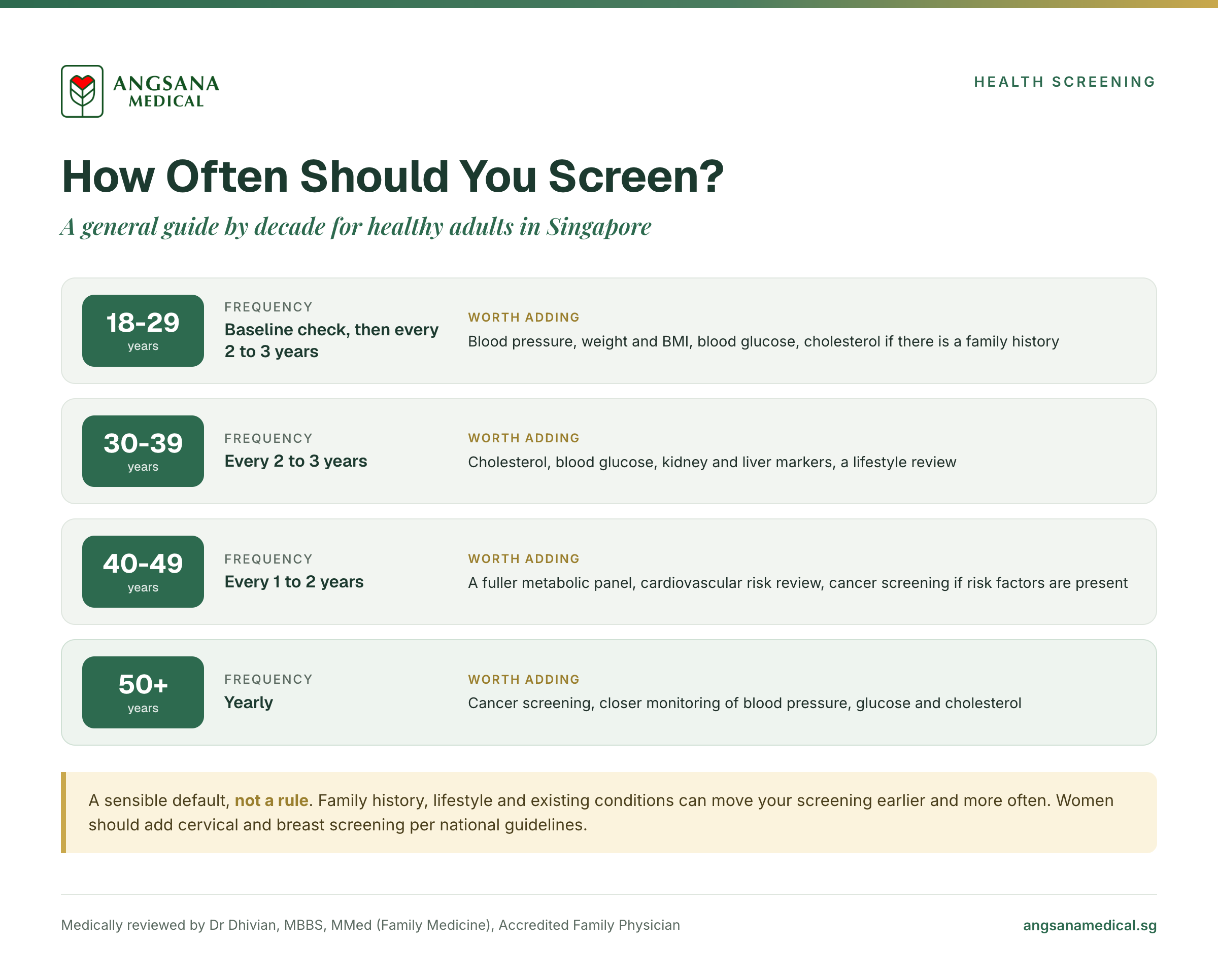
The short answer: it depends on your age and your risk
It is one of the most common questions we hear at the clinic. Do I really need a health screening every year, or is that just clever marketing? The honest answer is that it depends, and the two things it depends on most are your age and your personal risk.
Think of a health screening less as a yearly ritual and more as a way of catching quiet problems early. Many of the conditions that affect Singaporeans, such as high blood pressure, high cholesterol and type 2 diabetes, develop without obvious symptoms. You can feel completely well while a number quietly drifts in the wrong direction. A well-timed medical check-up is simply a way of looking under the bonnet before a small issue becomes a costly one.
The flip side is that more is not always better. A young, healthy adult with no family history and no risk factors usually does not need an exhaustive panel every single year. Over-screening can lead to false alarms, repeat tests and unnecessary worry. The goal is the right test at the right interval, not the longest possible list.
So when people ask how often health screening should happen, we usually reframe it. The starting point is age, because risk rises steadily as we get older. From there, we adjust for your individual story. Someone of 35 with a father who had a heart attack at 50 is in a very different position from someone of 35 with no such history, even though they are the same age on paper.
That is the logic behind the general guidance below. Use it as a sensible default, then let your doctor personalise it. The benefits of regular health screening come not from the number of tests, but from screening at intervals that actually match your situation and from acting on what you find.
Health screening by age: general Singapore guidance
Below is a general guide to how often a healthy adult might consider a health screening, and what is often worth adding as you move through each decade. Treat these as starting points rather than rigid instructions. The right plan for you may look different, and it should be confirmed with a doctor.
General health screening guide by age (healthy adults, Singapore)
| Age band | Suggested frequency (if generally healthy) | Screens worth adding |
|---|---|---|
| 18 to 29 | A baseline check, then about every two to three years | Blood pressure, body weight and BMI, blood glucose, cholesterol if there is a family history |
| 30 to 39 | Every two to three years | Cholesterol, blood glucose, kidney and liver markers, lifestyle review |
| 40 to 49 | Every one to two years | Fuller metabolic panel, cardiovascular risk review, cancer screening if risk factors are present |
| 50 and above | Yearly | Cancer screening, closer monitoring of blood pressure, glucose and cholesterol |
A few important notes. Women should add cervical and breast screening in line with national guidelines, which generally begin in adulthood and continue at set intervals, separate from the general schedule above. And the headline rule across every band is this: anyone with risk factors, such as a relevant family history, smoking, raised blood pressure or an existing condition, should usually screen earlier and more often than the healthy default. Those who desire greater certainty can also do more frequent health screenings.
This is also why a one-size-fits-all package bought online can be a blunt tool. It may include tests you do not need and miss ones you do. Speaking to a doctor first, ideally one who can also see you through our health screening service, helps make sure the panel fits the person.
It is less about age, more about your risk markers
Age is the convenient starting point because it is easy to look up. But in practice, your individual risk markers often matter more than the number on your birthday. Two people of the same age can need very different screening plans.
The first and most powerful factor is family history. If a close relative had heart disease, stroke, diabetes or certain cancers, especially at a younger age, your own risk is higher and screening may need to start earlier. This is genuinely useful information, so it is worth knowing your family's medical background and sharing it with your doctor.
Lifestyle is the next big lever. Smoking raises the risk of cancer and heart and lung disease. Regular heavy alcohol use affects the liver and blood pressure. Being significantly above a healthy weight increases the risk of diabetes, high cholesterol and joint and heart problems. None of these mean something is wrong today, but each is a reason to monitor more closely.
Then there are existing conditions. If you already live with high blood pressure, diabetes or high cholesterol, screening is no longer an occasional check. It becomes ongoing monitoring to make sure your numbers stay controlled and that no complications are developing quietly. The interval here is set by your doctor, not by a generic schedule.
This is where having a regular doctor pays off. A family doctor who knows your history can weigh all of these factors together and decide what actually needs watching, rather than testing everything by default. It is the difference between a screening that is built around you and one bought off a shelf.
The practical takeaway is simple. Use the age guide as a floor, then move your screening earlier and more frequent if your risk markers point that way. If you are unsure where you sit, that itself is a good reason to have a conversation with a doctor.
What a good health screening actually covers
A health screening should do more than take your blood pressure and weigh you. Those basic vitals matter, but on their own they paint only part of the picture. A thorough medical check-up looks across several areas, with the exact mix tailored to your age, sex and risk.
The first area is metabolic markers. These are the numbers that quietly signal how your body is handling the daily demands placed on it. These are some examples of basic metabolic markers:
- Blood pressure, a key indicator of heart and kidney health.
- Blood glucose, to flag prediabetes or diabetes early.
- Cholesterol and related lipids, which influence cardiovascular risk.
- Kidney and liver function, which can reveal strain before symptoms appear.
The second area is cancer screening, guided by national recommendations. Depending on your age and sex, this can include colorectal screening, cervical screening and breast screening. The aim of these is early detection. Picking up certain conditions at an earlier stage can, in some cases, open up more options for management, though this varies by condition and from person to person. Your doctor will advise which apply to you and when. With biotechnological advancements, Multi-Cancer Early Detection (MCED) tests are now available at selected clinics, such as Angsana Medical. These tests are designed to pick up cancers earlier with just a simple blood test.
The third area is nutritional deficiency screening. Even with a full diet, some people run low on iron, vitamin D, vitamin B12 or other nutrients, which can show up as tiredness, low mood or poor concentration. Picking this up is often a quick fix that makes a real difference to how you feel day to day.
The fourth area is longevity and lifestyle markers. This is where screening shifts from simply spotting disease to actively supporting how well you age. It can include a broader look at metabolic health, body composition and the lifestyle habits that drive long-term wellbeing. For people who want to focus on this, our longevity and lifestyle medicine approach goes deeper than a standard panel.
A good screening, then, is layered. Basic vitals, metabolic markers, age-appropriate cancer screening, a nutritional check and a view on longevity. You do not need every test every time. What you need is the combination that is right for you, chosen with a doctor rather than guessed at.
 A doctor going through health screening results with a patient at Angsana Medical in Singapore.
How to make your screening worth it
Here is the part that is easy to overlook. A health screening only has value if you understand the results and do something with them. A folder of numbers you never revisit is a missed opportunity, and unfortunately it is a common one.
The single most important step is to review your results with a doctor who knows your history. The same number can mean different things for different people. A cholesterol reading that is fine for one person may warrant action in another with a family history of heart disease. A doctor can read each result in the context of your medications, your lifestyle and your past results, then tell you what genuinely matters and what does not.
This is also where borderline results are handled sensibly. Not every slightly off number needs treatment. Sometimes the right move is to repeat a test, sometimes it is a lifestyle change, and sometimes it is a referral. Without that interpretation, people either panic over harmless variations or, worse, ignore a result that mattered.
Continuity is what makes this powerful. When the same clinic holds your screening history year after year, your doctor can see trends rather than isolated snapshots. A glucose level creeping up slowly over three checks tells a far more useful story than a single reading ever could. That trend is often the earliest warning you will get.
So when you plan your next check-up, build in the follow-up from the start. Book the screening, then book the review. Bring your questions, your current medications and any symptoms you have noticed. Walk out with a clear understanding of where you stand and one or two concrete next steps, whether that is a repeat test, a lifestyle adjustment or simply a date for the next screening.
Done this way, a health screening stops being a box to tick and becomes a working part of looking after yourself. The numbers are only the beginning. The conversation that follows is where the real benefit lies.
Not sure how often you should be screening?
Every person's risk is different, so the right schedule for you is best decided with a doctor who can take your history into account. Our clinic at 1 Everton Park, near Outram Park and Tanjong Pagar MRT, can help you plan a screening that fits your age, lifestyle and family history, then walk through the results with you.
Frequently Asked Questions About Health Screening
How often should I do a health screening in Singapore?
As a general guide, healthy adults in their 20s and 30s can screen every two to three years, those in their 40s every one to two years, and those aged 50 and above yearly. These are starting points, not fixed rules. If you have a family history, existing conditions or lifestyle risks such as smoking, your doctor may recommend screening earlier and more often.
At what age should I start health screening?
Most healthy adults benefit from a baseline health screening in their 20s, even if it is infrequent, so there is a record to compare against later. People with a strong family history of conditions such as diabetes, high cholesterol or early heart disease may be advised to start earlier. Speak with your doctor to set a sensible starting point for you.
What is included in a full health screening?
A useful health screening usually covers metabolic markers such as blood pressure, blood glucose, cholesterol and kidney and liver function, plus age-appropriate cancer screening such as colorectal, cervical and breast screening per national guidelines. Many screenings also check for nutritional deficiencies and review lifestyle and longevity markers. The right panel depends on your age, sex, risk profile and lifestyle goals, so it is worth personalising with a doctor.
Is a yearly health screening really necessary?
Not for everyone. A young, healthy adult with no risk factors usually does not need a full screening every year. However, it may be beneficial for those with personal or family risk factors as well as for those who desire greater certainty. Our doctor can help you choose the right screening at the right interval, not simply more tests.
Should I see a doctor to interpret my screening results?
Yes. Numbers on a report only become useful when they are read in the context of your history, physical examination findings, medications and lifestyle. A doctor who knows your background can explain what a borderline or abnormal result means for you, decide whether a repeat test or referral is needed, and help you act on it. Reviewing results with a doctor is what turns a screening into a plan.